Order Total (1 Item Items):
Shipping Destination:

Manuscripts (202 results)
Skip to main search results
Search filters
Product Type
- All Product Types
- Books (127)
- Magazines & Periodicals (No further results match this refinement)
- Comics (No further results match this refinement)
- Sheet Music (2)
- Art, Prints & Posters (No further results match this refinement)
- Photographs (No further results match this refinement)
- Maps (No further results match this refinement)
- Manuscripts & Paper Collectibles (73)
Condition Learn more
- New (No further results match this refinement)
- As New, Fine or Near Fine (36)
- Very Good or Good (53)
- Fair or Poor (No further results match this refinement)
- As Described (113)
Binding
Collectible Attributes
- First Edition (26)
- Signed (8)
- Dust Jacket (No further results match this refinement)
- Seller-Supplied Images (202)
- Not Print on Demand (202)
Language (6)
Free Shipping
Seller Location
Seller Rating
-

Pacific Oyster Breeding in Pendrell Sound, 1975
Published by Manuscript report series No. 1406, 1406
Fisheries research board of Canada, Manuscript report series No. 1406, November 1976, Pacific Biological Station, Nanaimo, BC, 21,50x27,50 cm, broché, 60 pages environ Bon état - Pour les envois hors de France, la tafication «livre & brochure» pour les frais de port a disparue.Les frais de port annoncés correspondent à une moyenne. Ils seront calculés au plus juste en fonction du poids de votre article.
-

Pacific Oyster Breeding in British Columbia, 1976
Published by Manuscript report series No. 1419, 1419
Fisheries research board of Canada, Manuscript report series No. 1419, April 1977, Pacific Biological Station, Nanaimo, BC, 21,50x27,50 cm, broché, 60 pages environ Bon état - Pour les envois hors de France, la tafication «livre & brochure» pour les frais de port a disparue.Les frais de port annoncés correspondent à une moyenne. Ils seront calculés au plus juste en fonction du poids de votre article.
-
Easter Day limited signed edition #80/145, last stanza in manuscript, fine copy
Language: English
Published by Np: no publisher, nd., 1234
Seller: J & J House Booksellers, ABAA, Kennett Square, PA, U.S.A.
Seller rating 5 out of 5 stars

First Edition Signed
Hardcover. Condition: Near Fine. 1st Edition, Limited Edition. First edition limited #80/145 signed and numbered by the author with the final stanza of four lines in the author's hand, pp. (6). Original green cloth backed red lettered boards in original boards slipcase. Fine clean copy in near fine slipcase. H11040 All Items Are Sent Insured. Insurance charges are included in the Shipping & Handling Charges. International buyers please be aware that we are not responsible for and do not include or estimate customs duties, fees or taxes in any way in our listings. We ship all orders within 2 to 5 days of cleared payment. The estimated shipping times and estimated arrival dates given in the listing are not provided by us and are usually wrong or very misleading. We do not pay for any foreign taxes or customs duties and have no information about them. These are the responsibility of the buyer. We do not create and are not responsible for shipping times or delays associated with customs and international shipping. Signed by Author(s).
-
Legenda aurea
Published by France, 1300
Seller: Heritage Book Shop, ABAA, Beverly Hills, CA, U.S.A.
Seller rating 5 out of 5 stars
First Edition
France: 1300. Full Description: [VORAGINE, Jacobus de. Legenda aurea. France: n.d.c.a. 1300]. Illuminated manuscript on vellum. Small quarto (7 3/4 x 6 inches; 198 x 150 mm.). 264 leaves. Apparently complete. Two columns of forty lines, written written in a small regular gothic script. Justification: 6 1/8 x 4 1/8 inches; 135 x 105 mm. Early ink foliation to the upper outer corner of the text [iiii, 1525]. Rubrics in red. Running headings in red above each column. Alternately red or blue one-line initials for the list of contents (fols. 1v-2). Major sections introduced by large 5- to 9-line puzzle initials in blue and red with penwork flourishingalong the text column in both colours at pp. i, 1, 143 (Resurrection), and 206 ('Tempus peregrinationis'), three-line initials alternately blue flourished in red, or vice versa, introduce the lesser feasts and the etymologies of names etc., one-line initials and paraphs alternately blue or red. Some neat annotations and corrections in the margins. Bound in 18th-century French polished dark red calf. Spine stamped in gilt with floral device. Spine with two leather labels, lettered in gilt. One in olive-green leather with 'Legenda Aurea', and the other in black with 'MS du XIV siecle' at the foot. All edges dyed blue. Marbled endpapers. Some rubbing to edges and corners. A piece of adhesive tape affixed to both front and back boards. The opening and closing leaves a bit darkened and some staining towards the end. A few small cuts or tears and some natural vellum flaws to margins of some leaves. A small hole in the margins of pages 230 and 308 not affecting text. Page 254 with a hole and a tear, just touching one letter. Page 496 with two small holes, just touching a few letters. Overall a very good copy. Content: Jacobus de Voragine, Legenda Aurea, 'Incipit prologus super legendas sanctorum quas compilavit frater Jacobus nacione Januensis de ordine fratrum predicatorum. Universum tempus presentis uite in quatuor distinguitur [.] ab octavo pentecosten usque ad adventum domini. Explicit prologus super legendas sanctorum.', p. i; 'Incipiunt capitula tocius libri. De aduentu domini / De sancto andrea apostolo / [.] / De dedicatione ecclesie', pp. i1; main text: 'De adventu domini. Adventus domini per quattuor septimanas agitur [.] vivit et regnat deus per omnia secula seculorum. Amen. Expliciunt legende sanctorum deo gratias', pp.1525. Jacobus de Voragine, who became a Dominican in 1244 and died in 1298, after six years as bishop of Genoa, wrote various works of which the Golden Legend, perhaps of the 1260s, was by far the most successful. A compilation to accompany the major feasts in the church calendar, the Golden Legend details the lives and miracles of saints and explicates events in the lives of Christ and the Virgin, ordered according to the liturgical year. It must have been the most widely consulted authority on these matters and is consequently an invaluable insight into what was generally known by writers, artists, and their patrons. About a thousand manuscripts survive, in the original Latin and in translation, and about a hundred printed editions had appeared before the sixteenth century. The original text of 176 chapters was expanded over the years with updating and with feasts specific to certain localities. It was also translated into many languages including the first English edition by William Caxton in 1483 It was also translated into many languages (including English, by William Caxton). Illumination: The flourished initials, and border decoration are northern French or south Netherlandish in character. Provenance: (1) Pierre Goyet (17241794), numismatist, archaeologist, bibliophile, and canon of Villefranche-sur-Saone (north of Lyon), who died at the guillotine (on whom, and for a reproduction of his book label, see W. Poidebard et al., Armorial des bibliophiles de Lyonnais, Forez, Beaujolais et Dombres (Société des bibliophiles lyonnais, 1907), pp. 27879): his book-label. Goyet's library was sold in Lyon on 10 April 1809 at auction: the catalogue is extremely scarce. (2) Unidentified 20th-century German-speaking dealer, with his typescript description stuck to the first flyleaf. (3) Howard Lehman Goodhart (1884-1951), stockbroker and bibliophile: his leather book label inside upper cover. By descent to his daughter: (4) Phyllis Goodhart Gordan (1913-1994): her leather book label inside upper cover, MS 28. On deposit at Bryn Mawr, BMC 10. Published in De Ricci, Census, II, p.1682, no 28. HBS 69543. $85,000.
-
An Illuminated Book of Shi'a Prayers on Coloured Paper dedicated to the Governor of Fars.
Published by Qajar Persiacopied by Abdul Wahhab al-Tabtaba'i dated AH 1843-1844 CE., 1259
Seller: Robert Frew Ltd. ABA ILAB, London, United Kingdom
Association Member: ABA ILAB PBFA
Seller rating 5 out of 5 stars
Complete illuminated manuscript in Arabic on 26 leaves of polished paper of various colours including blue, yellow, pink, peach, green, violet, and grey, 9 lines of neat black naskh per page set within cloudbands against a gold ground and framed within illuminated border, the titles of each prayer (mostly in Persian) picked out in red against a gold ground within cartouches, with catchwords. The manuscript opens with an exquisitely illuminated frontispiece with gold and polychrome decoration filling the page around the beginning of the text, itself copied in cloud-shaped reserves on a gold ground. The text on f.1b is crowned by a magnificent headpiece and framed with intricate scrollwork filled with blossoming flowers and gilt foliate decoration. In a contemporary Persian binding of red morocco, sides decorated with two gilt frames, pastedowns of marbled paper, two yellow flyleaves. Folio: 20.5 x 12.5 cm. Text panel: 14 x 8 cm. Provenance: Oval blindstamp with the name of 'Lumsden' to three leaves, in each instance to the lower corner, enclosing a crown and a date of 1841, with additional illegible writing beneath. Lumsden could likely refer to a member of the Lumsden family, whose members include the famous orientalist Matthew Lumsden (1777-1835), author of a Persian Grammar (Calcutta, 1810) and an Arabic Grammar (Calcutta, 1813); and his cousin Thomas Lumsden, author of 'A Journey from Merut in India to London' (London, 1822). The blindstamp in this manuscript likely belongs to Lieutenant-General Sir Harry Burnett Lumsden (1821-1896). Born aboard the East India Company's ship Rose in the Bay of Bengal, the son of a British Army Colonel Thomas Lumsden, C.B., he was shipped to Scotland to study at age 6, and returned to India at age 16. Lumsden joined the 59th Bengal Native Infantry in 1838, was present at the forcing of the Khyber Pass in 1842. He fought in the first and second Sikh Wars, being wounded at Sobraon and would later become assistant to Sir Henry Lawrence at Lahore in 1846. Inner hinges strengthened with modern paper, a few trivial blemishes, in excellent condition overall. This collection of 19 prayers, including Du'a Ehtejab, Du'a al-Sabah, and D'ua Kumayl, amongst many others, was copied by a scribe called Abdul Wahhab al-Tabtaba'i and dedicated to Muhammadquli Khan al-Baki (1224-1284 AH, 1828-1867), governor of Fars, whose name is picked out in gold on the final leaf. References: Mahdi Bamdad, 'arh-i hal-i rigal-i Iran dar qarn-i 12 wa 13 wa 14 higri' (Biography of Iranian Politicians), Vol 3, page 471.
-
An attractive Qur'an, lithographed from a manuscript copied by Muhammad Abdulaziz,
Published by Bombay Fath al-Karim publishing house dated Shawwal AH 1883 AD, 1300
Seller: Shapero Rare Books, London, United Kingdom
Association Member: ABA ILAB PBFA
Seller rating 4 out of 5 stars

Small folio (25.8 x 34.4 cm), lithographed throughout in Arabic, from a manuscript copied in elegant naskh script, with catch-words, marginalia and decorated head-pieces, double-ruling and pagination, verses marked with spheres, first leaf laid-down in places, a few small marginal tears (not affecting text), particularly to first few leaves, leaves evenly age-toned; housed in contemporary leather over pasteboards with flap, covers and flap ruled, some small stains and a hole to the leather on the lower board, text-block detatched from binding (gatherings holding firm). A surprisingly rare example of a large-letter Indian Qur'an, very attractively presented and prepared for print by the Fath al-Karim publishers from a manuscript copied by Muhammad Abdulaziz. The invention of the printing press with moveable type was revolutionary in fifteenth-century Europe with the development of the Gutenberg press However, this printing revolution didn't take off with the same vigour in the Muslim world, and arguably printing wasn't fully established in the Middle East until the 19th century with the invention of lithography. Aside from the obvious difficulties in the adaptation of the Arabic script to type, Islamic cultures were adapted to the tradition of the written word through the art of calligraphy. By the mid-19th century lithography was very well established in major cities such as Tehran, Tabriz, Bombay and Calcutta and printed Qur'ans were mass-produced throughout these regions. Despite this, large-letter formats such as the present example are seemingly more scarcely available and would likely have been produced primarily for use in a madrasa (or similar educational establishment) for ease of use for reading as a group or in a classroom setting.
-
Tarikh'i Pitr'i Kabir [and] Tarikh'i Sharl'i Davazdahhum, Histories of Charles XII and Peter the Great, translated from Voltaire's 'Histoire de l'empire de Russie sous Pierre-le-Grand'.
Published by Qajar Persia dated 10 Dhu'l Qa'da AH 30 December 1873, 1290
Seller: Shapero Rare Books, London, United Kingdom
Association Member: ABA ILAB PBFA
Seller rating 4 out of 5 stars
Single volume, illuminated manuscript on paper with fine marbled paper borders, in Farsi, 141 leaves, complete, 323 x 215 mm; single column, 11 lines to the page written in neat nasta'liq script in black ink, occasional headings and significant words in blue, inner margins ruled in gold and blue, outer borders throughout decorated with fine marbling, one fine illuminated opening headpiece, later ink inscription to recto of first leaf, else very clean and bright condition; contemporary leather over pasteboards, covers and extremities a little scuffed and rubbed. This extraordinary manuscript is most probably the first translation of Voltaire from French into Persian. Little is known about the life of the translator, Mirza Reza Tabrizi, however he is known to have been working as a civil servant in Khorasan in 1846 and spent the years 1853-58 as an interpreter and instructor in French at the Dar al-Fonun. This manuscript is particularly striking for the remarkable decorated marbled borders, of many varying designs and patterns, that adorn all the text pages. The use of marbled paper borders in a bound manuscript, as here, is very unusual. Marbled paper was often used to decorate album pages and calligraphic panels from the sixteenth century onwards and was very much a decorative tool elevating the design and appeal of a single artistic creation (i.e. a miniature or calligraphic exercise), it's use to adorn the margins of every text leaf is a sign of great luxury and decadence. The only other known textual manuscript to include marbled borders to this degree was copied by the same scribe as the present manuscript and was entitled Tarikh'i Iskander (History of Alexander the Great), assembled by James Campbell; a reference to this primary text is given in the preface of the other manuscript: 'Ibn Muhammad Khan Safdar 'Ali is to produce this text as well as the History of Peter the Great' thus confirming that the two volumes were undeniably associated at the time of production and assembled in this style at the bequest for the same patron. Although notably the secondary volume was completed a year later and in Kabul, Afghanistan, indicating that the patron of these works was likely travelling with the scribe and engaging with them as they worked. For more information on the secondary associated manuscript, see item 33 in Shapero Rare Books' Catalogue Maghreb to the Far East (London, 2023).
-
Arshad al-Hayir alaa Maerifat Wade jadawil wa khutut fadl aldaayir. an astronomical compilation.
Published by Isfahan AH 1807 AD, 1222
Seller: Shapero Rare Books, London, United Kingdom
Association Member: ABA ILAB PBFA
Seller rating 4 out of 5 stars
Single volume, decorated manuscript on paper, in Arabic, 78 leaves, a compilation manuscript, lacking first few leaves (only affecting one section of text), 212 x 155 mm; single column, 20 lines black informal nasta'liq script, some overlining in red, numerous diagrams in the text and to the margins, also in red, extensive marginal annotations throughout in a contemporary hand, upper corner of first free endpaper torn with loss, some light thumbing to text; housed in contemporary limp leather remains of paper label pasted to upper cover, tail of spine and hinges cracked, extremities lightly rubbed. A compilation of various excerpts on astronomy, copied from an earlier manuscript dated 990 AH (1582). This manuscript was evidently copied by it's owner as a working copy for personal use, and includes their extensive contemporary annotations to the margins.
-
A treatise on Geometry and Astronomy.
Published by India Jumadi AH 1867 AD, 1284
Seller: Shapero Rare Books, London, United Kingdom
Association Member: ABA ILAB PBFA
Seller rating 4 out of 5 stars
Single volume, illuminated manuscript on thin polished Indian laid paper, text-block sprinkled in red and pink, in Farsi, Persian manuscript on paper, black ink on paper, 34 leaves, 268 x 160 mm; 16 lines bold nasta'liq verging on shekasteh, text-block ruled in gilt, numerous diagrams in the text and adorning the margins, most of these in gold, some contemporary annotations to margins, a few spots to preliminary leaves, gilt ruling to text-block oxidised and caused closed tears in come instances (mostly to inner ruling close to gutter), some margins repaired; contemporary red sheep over pasteboards, covers ruled in blind with central stamped motifs also in blind, rebacked and edges repaired, new endpapers and pastedowns, covers rubbed. An attractive treatise on geometry and astronomy, likely copied in India for a certain Alim al-Din Hussayn bin Abd'Allah al-Ansari in 1867 AD. The work includes many diagrams in the text showing various geometrical shapes, diagrams of stars and planets, and diagrams of various eclipses and spheres in orbit.
-
Al-Hikma al-Mutaaliya fi al-Asfar al-Aqliyya al-Arba'a (The Transcendent Theosophy in the Four Journeys of the Intellect).
Published by Qajar Persia dated 12 Dhu'l-Qa?da AH 1823 CE., 1238
Seller: Robert Frew Ltd. ABA ILAB, London, United Kingdom
Association Member: ABA ILAB PBFA
Seller rating 5 out of 5 stars
Illuminated manuscript on fine polished paper, copied by Abdullah bin Mohammed al-Mashhadi. Volume I: 232 leaves, single column, 25 lines in an elegant black naskh hand with rubrication (key words and headings in red) and occasional overlining; with a large gilt and polychrome illuminated heading at the opening. Condition: minor scattered spotting and a very small marginal tear to fol. 237, otherwise exceptionally clean and crisp. Volume II: 140 leaves, written in the same fine naskh with rubrication and overlining, also opening with a large illuminated heading. Condition: extremely clean and fresh throughout. Leaf size 300 × 190 mm. Both volumes bound in contemporary roan, expertly rebacked in tan leather; light rubbing at extremities; overall very presentable. An attractive Qajar-period copy of Mulla ?adra's celebrated synthesisal-Hikma al-muta?aliyathe foundational text of the later Iranian seminarian curriculum, prized not only for its doctrinal significance (primacy and gradation of existence, substantial motion) but also for its reception history in nineteenth-century Iran. Finely preserved illuminated sets from this period, in such condition, are uncommon on the market. Biography: Mulla Sadra (Sadr al-Din Muhammad Shirazi, 1571/721640) was the most influential intellectual figure of the late Safavid period, remembered not only as a thinker but as the founder of the school of al-hikma al-muta?aliya, or Transcendent Theosophy. Born in Shiraz, he received his early training under prominent teachers in Isfahan, most notably Mir Damad and Shaykh Baha? al-Din al-?Amili (Shaykh Baha?i). This Isfahan period introduced him to the traditions of Avicennian peripateticism, Suhrawardi's Illuminationism, and the metaphysics of Ibn ?Arabi, all of which he would later weave into his own synthesis. After years of study, Sadra withdrew to the village of Kahak near Qom for a period of seclusion and ascetic practice. There he combined rigourous scholarship with spiritual discipline, producing early drafts of his later works and cultivating the view that intellectual activity must be inseparable from inner purification. Eventually he returned to public life in Shiraz, where he was appointed to teach at the Madrasa-yi Khan, an institution founded under Safavid patronage. During this later phase he composed the works that secured his intellectual legacy. In addition to his vast al-Asfar al-Arba?a, he wrote shorter treatises such as al-Masha?ir (The Book of Metaphysical Prehensions), al-Shawahid al-rububiyya (The Divine Witnesses), and several Qur?anic commentaries and eschatological treatises, including his celebrated discussion of bodily resurrection (al-hashr). These writings reveal not only his metaphysical commitmentsthe primacy and gradation of existence, the doctrine of substantial motion, and the unity of the intellect and intelligiblebut also his conviction that true philosophy culminates in spiritual ascent and visionary knowledge. Mulla Sadra died in Basra in 1640 while on pilgrimage to Mecca, leaving behind an intellectual system that reshaped the philosophical landscape of Iran and the broader Islamic world. His works were copied extensively during the Qajar period, ensuring their survival and embedding them into the curricula of Shi?i seminaries. Even today, the Asfar remains central to advanced study in Qom and elsewhere, while modern scholarship has secured his place not only in Islamic intellectual history but also in global philosophical discourse. Mulla Sadra's biography thus reflects a life devoted to bridging rational inquiry, mystical experience, and theological reflection, a synthesis that continues to inform debates on metaphysics, psychology, and eschatology. The Transcendent Theosophy in the Four Journeys of the Intellect (al-Asfar al-Arba'a) Mulla Sadra's al-Hikma al-Muta?aliya fi al-Asfar al-?Aqliyya al-Arba?acommonly called the Asfar or "Four Journeys"is both his magnum opus and the architectonic expression of his hikma, or transcendent wisdom. Written and revised over several decades, it serves simultaneously as an encyclopaedic synthesis and a spiritual itinerary: the intellect's gradual passage through ontology, cosmology, theology, and anthropology. Structured around four symbolic "journeys," the text explores, in sequence, the nature of being and its modalities, the constitution of the cosmos through substance and accident, the divine names and attributes, and finally the human soul in its genesis, development, death, and return. More than a mere summa of antecedent traditions, the Asfar reframes Avicennian, Illuminationist, and mystical doctrines within an experiential metaphysics in which rational argumentation, spiritual unveiling, and scriptural revelation converge. Among the most influential doctrines articulated in the Asfar is the principle of the primacy of existence (asalat al-wujud), which asserts that existence is ontologically fundamental and essences are only conceptual abstractions. This reorients the metaphysical project away from essentialism and grounds it in wujud as a single but graded reality. Closely related is Sadra's teaching on the modulation or gradation of being (tashkik al-wujud), whereby existence is analogically one yet admits of intensification and diminution across levels of reality. A further cornerstone is the doctrine of substantial motion (al-haraka al-jawhariyya), which extends change from accidents into substances themselves, reimagining nature as an ongoing process and providing the basis for the soul's substantial growth toward higher intensities of being. The epistemological correlate of these doctrines is the unity of the intellect and the intelligible, according to which knower and known coincide in act during genuine intellection, a view that supports the ascent staged throughout the Asfar. The method of the work is both synthetic and dialogical. Avicenna supplies metaphysical scaffolding, Suhrawardi contributes the ontol.
-
C13th Psalter, Flanders on parchment, superbly illuminated throughout.
Language: Latin
Published by Flanders, 1250
Seller: Stephen Butler Rare Books & Manuscripts, London, United Kingdom
Seller rating 5 out of 5 stars
Manuscript / Paper Collectible
Description Composed of 204 leaves, the last three blank, missing a quire at the beginning with Calendar, Psalms 1 to 20 and 10 leaves in the text, probably with large initials. Text in Gothic script on a single column of 18 lines, lead-mine ruling. Collation not practicable. Very good condition, only small reinforcements in the parts corroded by acid ink. Binding Spanish 16th-century leather binding with gold decorations, restored and reassembled, gilded edges and with traces of engraving. Text The first leaf is meant to be the last and was inserted by mistake by the binder, just as leaves 130 and 150 were exchanged in position. ch 1, final prayers for the Office of the Dead; ch 2, Psalm 20, 4 ? you ?capite ejus coronam de lapide pretioso; ch 171v, end of Psalm 150, ?Omnis spiritus laudet Dominum Isaiah 12 follows: Confitebor tibi, Domine, quoniam iratus es mihi; Conversus est furor tuus, et consolatus es me?; ch 172, Isaiah 38: Ego dixi in dimidio dierum meorum: Vadam ad portas inferi; quaesivi residuum annorum meorum?; ch 173v, Samuel 2: Exultavit cor meum in Domino, et exaltatum est cornu meum in Deo meo: dilatatum est os meum ?; ch 174v, Exodus,15: Cantemus Domino : gloriose enim magnificatus est, equum et elevatorum dejecit in mare; ch 176, Habakkuk 3: in medio annorum vivifica illud; in medio annorum notum facies : cum iratus fueri?; ch 178, Deuteronomy 32: Audite, caeli, quae loquor: audiat terra verba oris mei ?; ch 183, Daniel 3, 57: Benedicte, omnia opera Domini, Domino: laudate et superexaltate eum in saecula?; ch 184v, Te Deum; ch 186, Luke 1,68: Benedictus Dominus Deus Israel, quia visitavit, et decisit redemptionem plebis suae? ch 187, Magnificat; ch 188, Nunc Dimittis, follows Athanasian Creed; ch 191v litanies; ch 194v Office of the Dead. Provenance 1. The Flemish provenance is attested by some Saints remembered in the Litanies: Vedast of Arras, Bavo of Ghent and Winnoc of Wormhoudt. 2. Ex libris manuscript by an eighteenth-century hand on the la st leaf: Ceste libro eppen?[illegible]. Illumination The decoration includes 3-line initials, in burnished gold with red and blue background and extensions on one side of the page. Many more smaller initials, in gold or blue alternating with contrasting penworks and line fillers complete the ornament.
-
An illuminated Qur'an, copied by Isma'il Najib, Shumen, Bulgaria.
Published by Ottoman Empire dated AH/1849-50 AD., 1266
Seller: Robert Frew Ltd. ABA ILAB, London, United Kingdom
Association Member: ABA ILAB PBFA
Seller rating 5 out of 5 stars
Arabic manuscript on paper, 308 leaves, plus 4 fly-leaves, 15 lines to the page written in naskh in black ink, verses separated by gold and polychrome illuminated rosettes, within gold and black rules, hizb, sajda and juz' marked by illuminated floral marginal devices, surah headings in white thuluth on gold and polychrome illuminated panels, f.1b and 2a illuminated in gold and polychrome with rococo floral decoration against a gold ground pin-pricked with cintamani motifs, the colophon within similarly illuminated panels, in Ottoman gilt dark brown leather binding with flap, with fitted box. Text panel: 8 by 5.1cm. Leaf: 12.5 by 8.2cm. Isma'il Najib is recorded as a pupil of Ahmed Zarifi and teacher to Tentene-zade Seyyid Hasan Vehbi (Stanley 2009, p.248). Further Qur'ans by the scribe have sold in Christie's, London, 26 April 2018, lot 177; 26 October 2017, lot 229, and 12 October 1978, lot 7, and another was sold at Sotheby's, London, 21 November 1985, lot 390. The latter example is illuminated in a very similar manner to the present lot in a fully Rococo style, unlike the typical Shumen style of illumination. In the 19th century, one of the most important places of Ottoman manuscript production was Shumen, a strategically-important fortress in what is today Bulgaria. Tim Stanley and Süheyl Ünver have independently worked on the corpus of manuscripts there, identifying more than fifty Qur'anic scribes from the town, apparently divisble into three groups according to their original teacher: Seyyid Mehmed Nuri, Ahmed Zarifi, and Ahmed Nazifi (Tim Stanley, The Decorated Word, volume II. Oxford, 2009, p.226). By the 1850s, Qur'ans from Shumen had come to be remarkably homogenous: all observe the principle of ayet ber kenar, in which every page ends with a completed Qur'anic verse; all are written with 15 lines of text to a page; all have between 300 and 310 pages. The dimensions of these manuscripts are also fairly constant. Although these manuscripts were produced in quantities to make them available to many relatively prosperous subjects of the Ottoman Empire, Shumen Qur'ans were presented by Ottoman sultans to important figures including Ali Rif'at Pasha, the Khedive of Egypt, and al-Husayn, Sharif of Mecca. The production of Qur'ans in Shumen came under increasing pressure with the rise of lithographic printing, and came to a complete stop with Bulgarian indepedence in 1878. For a fuller discussion of the Shumen school of calligraphy, see Tim Stanley, "The Shumen Phenomenon", The Decorated Word, volume II. Oxford, 2009, pp.222-51. The illumination of Shumen manuscripts - though united by a Baroque idiom and a bright, pastel colour palette - exhibits some variety, suggesting that there were several different schools of illumination in the city, alongside the numerous calligraphers.
-
SINGLE LEAF FROM A PSALTER, IN LATIN, MANUSCRIPT ON PARCHMENT
Published by [England,, 1260
Seller: Tom W. Ayling, Wallingford, United Kingdom
Seller rating 4 out of 5 stars
A single leaf on parchment, c. 233 x 166 mm, from an attractive English Psalter with complex geometric line fillers. The leaf is ruled in ink, c. 171 x 120 mm (ruled), written on twenty-one lines in dark brown ink in a gothic textualis script, with line fillers in burnished gold, red, or blue, with single line versal initials in blue or gold, modern foliation in pencil to the lower margin. The decoration of this leaf appears unfinished, the alternating blue and gold initials lack their pen flourishing. The text contains Psalm 101:727. The text on the recto opens: 'Similis factu[s] su[m] pellicano solitudinis', ('Through the voice of my groaning'). This single leaf comes from a Psalter that was listed at one million pounds and went unsold in 2000 by Les Enluminures with Bruce Ferrini. The manuscript was later dismembered and individual or collections of leaves from the Psalter have come up for sale since. There are debates on the origin of this manuscript, whether it is English or French. England, specifically the north of England, has been attributed on the basis of the style of decoration. A very attractive example of an English manuscript leaf. There is some lightening of the script, some rubbing of the gilt letters and line fillers, particularly to the verso. If you would like this leaf framed with conservation glass for an additional fee, please contact us. Peter Kidd, The McCarthy Collection, III: French Miniatures (Ad Ilissum, 2021), pp. 120-25 no. 33.
-
Liber de fructibus penitentiae (alias Flores de penitentia or Summa aurea)
Published by [Southern France] (Provence?), 1325
Seller: Stephen Butler Rare Books & Manuscripts, London, United Kingdom
Seller rating 5 out of 5 stars
First Edition
Hardcover. Condition: Very Good. 1st Edition. Here is the text with accents removed: Physical Description MATERIAL Parchment the leaves c 125 x 95 mm NUMBER OF LEAVES i paper 93 I original parchment i paper FOLIATION Contemporary ink foliation in arabic numerals up to 99 then roman numerals showing that the first quire is out of sequence 25 36 13 24 37 99 c cv COLLATION 1 512 fols 25 72 6121 last leaf missing fols 73 83 712 fols 85 96 810 or 10 1 1 fols 97 105 and flyleaf quire signatures on the first rectos of some quires from the third onwards RULING Plummet ruled for two columns of 35 lines per page c 100 x 75 mm SCRIPT Written in a very small highly abbreviated gothic script rubrics in red BINDING Bound in 18th century French speckled medium brown leather over pasteboards the spine tooled in gilt with foliate ornaments and a black leather title piece lettered in gilt VIM sic A BEDOCI DEFRUC PCENIT sic MS XIVS Text The volume lacks its first quire and the second is misbound after the third it starts imperfectly in chapter 3 and ends non cesset salutaris operatio perseueret Amen followed by an interesting explicit Explicit liber de fructibus poenitentiae compilatus per fratrem followed by a blank space ordinis predicatorum de provincia Lumbardie et correctus et adauctus quantum ad titulos materias et auctoritates plures excerptus a Vincentio per fratrem Stephanum Bedocii de provincia Provincie Here we see that the scribe did not know the name of the author so he left a space in the hope that it might be filled in at some later date He states in some detail that the text has been revised and corrected by brother Stephanus Bedocius who was perhaps the scribe himself of the Dominican province of Provence The main text is followed by a list of contents of which only the second half survives on the back flyleaf one flyleaf having been lost it begins De meditacione dei circa beneficia communia fol 58 and ends De labore manuum fol ciij Old discussions of the text include J Quetif and J Echard Scriptores Ordinis Praedicatorum 2 vols Paris 1719 21 I pp 239 40 and A Teetaert Quelques Summae de poenitentia anonymes dans la Bibliotheque Nationale de Paris in Miscellanea Giovanni Mercati II Studi e Testi 122 Vatican City 1946 pp 311 43 More recently it has been inventoried by Morton W Bloomfield Incipits of Latin Works on the Virtues and Vices 1100 1500 AD Mediaeval Academy of America Publications 88 Cambridge MA 1979 p 426 no 4996 listing more than twenty manuscripts Here it is noted that There are perhaps several redactions of this work or several works under the same incipit i e a prologue beginning Quoniam peccantibus post baptismum mortaliter sola penitentia remedium est ad vitam and a main text beginning Rabanus or Ambrosius super Matth 21 Omnis inquit arbor que non facit fructus bonos cf Thomas Kaeppeli Scriptores ordinis praedicatorum medii aevi 4 vols S Sabina Rome 1970 1993 IV no 4008 The authorship is uncertain The work is often mistakenly attributed to Vincent of Beauvais due to the fact that he wrote a work with a similar title prologue and division into fifteen parts on which the present work is based It has also been ascribed to an unidentified Dominican Frater P or Frater Stephanus He apparently composed the work before 1303 when the province of Lombardy was divided into two upper and lower There is therefore new work to be done to distinguish the different texts or to ascertain how the various versions of the text relate to one another The colophon of the present manuscript suggests that it is perhaps a unique version Assuming that he was French the scribe reviser s first name would have been Etienne and the surname Bedoc can be found in Provence to the present day Decoration The beginning of each of the surviving fifteen books is introduced by a four to eight line initia.
-
Calculus temporum ecclesiasticus.
Published by [Possibly England,, 1360
Seller: Antiquariaat FORUM BV, Houten, Netherlands
Seller rating 5 out of 5 stars
£ 85,407.45
£ 21.82 shipping
Ships from Netherlands to Hong KongQuantity: 1 available
Add to basketWith no other known textual witnesses, this extremely interesting Latin calendrical manuscript must be considered a unique work, possibly of English origin. It was formerly the property of the bibliophile Sir Thomas Phillipps (1792-1872), who lends the work its title (and short catalogue description) on its wrappers.It appears likely that the manuscript had not been entirely completed by its scribe when it was bound, as there are a number of spaces left open in the text for diagrams which were never drawn in, as well as spaces for catchwords in the left margin of the pages (a later owner has completed a few of these). Throughout the manuscript, the text makes reference to these non-existent diagrams; these were perhaps intended to contain computational tables or similar, although the incipit does indicate significant astronomical content when it describes the "motus planetarum". The three final leaves, which are penned in a slightly different, but likewise contemporary hand, may be an attempt to complete the work textually.The paper itself is heavy, rather crude in manufacture, showing two watermarks: the first, three flowers on stems growing from a single bulb; the second, apparently two circles, one crossed diagonally. That the manuscript was written on paper at such an early date as the mid-14th century is striking: this early example of a European manuscript on paper, rather than vellum, would indeed be exceptionally early if it is in fact English, where paper manuscripts appear later than on the continent.Altogether, a fascinating example of a unique 14th-century manuscript in progress, and one with a rather unique construction, as well as no other surviving copies. The most notable previous owner of the manuscript was Sir Thomas Phillipps, who amassed one of the greatest private manuscript collections in English history.The provenance of the present work is as follows:1) Sir Edward Dering (1598-1644), antiquary and collector.2) Offered by Sotheby & Son, Catalogue of a valuable collection of autograph letters of distinguished persons, original documents, &c., 20 May 1831, lot 147.3) A note in pencil to inside front cover states "Dering Sale" with a faint date of 1865, apparently referring to the fourth and final sale, by Puttick & Simpson, of Dering's library.4) Sir Thomas Phillipps, 1st Baronet (1792-1872), with notes in his hand on the upper cover and his catalogue number on the first page.5) Later in the library of the printer and antiquarian George Maynard (1850-1917) of Worcester, Mass., with his notes on the manuscript and a partial transcription laid in.6) Thence to the lawyer and collector Eben Francis Thompson (1859-1939) of Worcester, Mass.; his name in pencil on an old envelope in which the MS was once retained.7) Later reportedly the estate of the late Calvin Israel, professor or English at SUNY Geneseo and friend of Samuel Beckett.With Phillipps' description is pasted to the inside front cover, and the first leaf shows "Phillipps Ms. 23256" inked in Phillipps' own hand in the lower margin. Minor water staining throughout, but otherwise quite well preserved.l Schoenberg Database 72245; Phillipps MS 23256 (Catalogus librorum manuscriptorum in bibliotheca D. Thomae Phillipps, pt. 4 [1871]: "Calculum Astronomicum, & Mathematicum de Motu Solis, & Astrorum . Dering Mss., Sale 674"); not listed by In Principio index. 19th-century paper wrappers, with the manuscript title on the front wrapper. Latin manuscript on paper. Brown ink in an early bastarda hand, the final three leaves in a slightly later (still quite contemporary) hand. Pages: 30 ll.
-
Privilegio rodado, granting the town of Escamjella to Yenego Lopez de Horozco.
Published by Segovia, Royal Chancery, 29. IX. 1344., 1344
Seller: Antiquariat INLIBRIS Gilhofer Nfg. GmbH, Vienna, A, Austria
Association Member: ILAB VDA VDAO
Seller rating 5 out of 5 stars
Manuscript / Paper Collectible
Large folio, 610 x 720 mm (with plica folded). Matted, framed and glazed (930 x 800 mm). Illustrated Castilian manuscript on vellum, 1 page. Folded and loosely contained within a handsome custom-made dark crimson quarter leather and cloth clamshell box with title giltstamped to spine. A fine, large manuscript document from the reign of Alfonso XI. The Royal Charter is written in Castilian vernacular with the royal names (Alfonso and that of his second wife, Maria of Portugal), opening device and King's seal painted in red, green, blue and beige (the latter occupying a large area at the centre of the document). - In the Charter, Alfonso grants the town of Escamjella (Escamilla) to Yenego Lopez de Horozco (the Alcarreño nobleman Íñigo López de Orozco, d. ca. 1355); he further commemorates the taking of Algeciras and the subjugation of Granada four years earlier, events which marked the effective end of Moorish power in Spain. - Granada's fall was brought about by the great naval victory of the Rio Salado in 1340, referred to in a separate passage. The King's admiral, Don Egidio Boccanegra, was sent with eleven galleys against the Moorish King of Granada, Yusuf Abu'l Hadchach, and Abul Hassan, Sultan of Morocco. The Spaniard defeated Yusuf's fleet of sixty ships and was rewarded with the title of Grand Admiral. The Charter present contains confirmations by Yusuf (styled Don Yucaff Abulhagege in the text) and Don Egidio, as well as leading lay and church princes and the King's own staff.
-
Nuhzat al-Qulub.
Published by Zand Persia dated 17 Muharram AH 1781 AD, 1243
Seller: Shapero Rare Books, London, United Kingdom
Association Member: ABA ILAB PBFA
Seller rating 4 out of 5 stars
Single volume, decorated manuscript on polished paper, in Farsi, 212 leaves, complete, 298 x 210 mm; single column, 19 lines nasta'liq per page, sections of important text inscribed in naskh or in red with occasional overlining in red, some diagrams and charts in the text, one illustrated map of the globe, a few smudges else clean and crisp internal condition; contemporary blind-stamped tan leather over boards, extremities lightly rubbed and a little scuffed. Hamdullah Mustawfi al-Qazvini (d. 1339 AD) took on an official role as the regional vizier for Ilkhanate Qazvin in the early fourteenth century before the Mongol invasion. He compiled three major works of prose and poetry during his lifetime: the first was Tarikh-i Guzida, a history of the world including the life of the prophets and pre-Islamic Kings, then came the Zafarnameh, a poetic work acting as a continuation of Firdowsi's Shahnameh taking the timeline right to the Ilkhanid era, and finally he wrote the Nuhzah at-Qulub, a geographical and historical treatise documenting the affairs and workings of the Ilkhanid Empire. The Nuhzat al-Qulub was al-Qazvini's most influential work because it provided invaluable statistical and geographical information about Persia and Mesopotamia under Ilkhanid rule, and documented important political events leading up to the Mongol invasion. There are two large double-page maps present in this work. The first is a detailed geographical study of thirteenth-century Persia and its surrounding territories, including the Arabian Peninsular, Central Asia and India, presented in the form of a chart. The second is a depiction of a globe taken from earlier sources, which is centred upon Mecca.
-
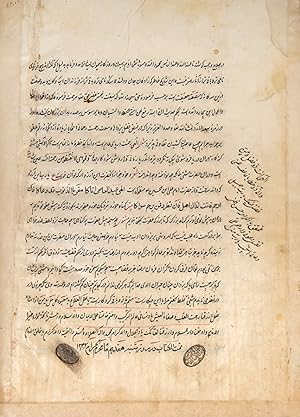
Decretales Gregorii IX [with gloss of Bernardo Bottoni of Parma]. Constitutiones novellae Innocentii IV [with gloss of Bernard of Compostella iunior]. Latin manuscript on vellum.
Published by [Probably Bologna, ca. 1260 (3rd quarter of the 13th century CE)]., 1260
Seller: Antiquariat INLIBRIS Gilhofer Nfg. GmbH, Vienna, A, Austria
Association Member: ILAB VDA VDAO
Seller rating 5 out of 5 stars
Manuscript / Paper Collectible
Decorated manuscript on vellum. Folio. 252 ff. 41-42 lines, 2 columns, surrounded by gloss in smaller script, headings in red, running titles and 1-line initials in red and blue, with larger blue and red flourished penwork initials throughout; 4 large decorated book openings formed of the name 'Gregorius' in tall combined capitals the width of the column. Extensive medieval notes and added glosses on every page in different hands, some slips of vellum bound in with further glosses. Contemporary brown leather binding over wooden boards on 4 tawed leather thongs; traces of 4 clasps; one metal catch remaining, stamped with the Paschal Lamb and the letter 'S'. An imposing folio manuscript of the most important legal textbook of the 13th century, in its original binding, and with extensive glosses and annotations. - The Decretals of Gregory IX became the fundamental text of canon law, controlling many aspects of secular as well as clerical life. This was what the Pope intended when in 1230 he ordered his confessor, Raymond of Peñafort, to organise into one authoritative text the existing five compilations of canon law with their subsequent additions, including his own. In 1234 the Pope sent the new work to the universities of Paris and Bologna and decreed that this was henceforth to be the official collection. Innocent IV expanded the Decretals with his own canons, known as the Novellae. The marginal annotations show that the present copy continued to be used well into the 15th century (indeed, it was owned by a French lawyer and judge in the 17th century). - Such a crucial text rapidly acquired commentators, with the Glossa Ordinaria, completed ca. 1266, being the most popular gloss, as opposed to independent commentary. The substantial commentary here is that of the jurist Bernardo Bottoni of Parma (d. 1266), who studied under Tancred of Bologna. The commentary of the Novellae Constitutiones is that of Bernard of Compostela junior, chaplain to Pope Innocent IV. The uniformity of text, essential for law operative throughout western Christendom, was reflected in the comparatively uniform layouts and systems of decoration. The penwork title panels with the name "Gregorius" and the flourished initials, found in volumes from both Italy and northern Europe, are part of a carefully ordered articulation of text and gloss designed for ease of use. - The vast majority of law books like this appear to have been made in Bologna, and were either sent out from there for sale or used by law students attending lectures at the university and brought home on completion of their studies. Comparatively few copies of this essential text remain in private hands. - Comprises: Decretals of Gregory IX, Book I (lacking the opening, beginning in Tit. II, Cap. VIII: "[.] evidenter quod apparet", ff. 1-57v); Book II, ff. 58-109v; Book III, ff. 111-163; Book IV, ff. 163v-182v; Book V, f. 182v-234v, ending, "[.] hommagium conpellatur. amen"; Novellae of Innocent IV, beginning "De rescriptis / Cum in multis iuris articulis [.]', ff. 235-252v. - Binding worn with professional repairs. Text lacks two leaves at the beginning and a few leaves at the end. Signs of considerable use over several centuries: some pages torn and frayed; a section torn from fol. 66 with loss of text; margins cut away from ff. 247-248 and 251 with loss of some text or gloss. Some worming at ends. - 1) The present manuscript was in France by the 15th century, to judge from the script of some added notes, the name "francoys" scribbled on fol. 187, and the pastedown from a French document. 2) Later owned by the judge and historian Denys de Salvaing de Boissieu (1600-83), of Vourey. 3) Sold at Grenoble at the sale of his library by M. Falque and Felix Perrin, Catalogue d'une Importante Bibliothèque composée d'ouvrages anciens, rares et précieux - Ancienne Bibliothèque de D. de Salvaing de Boissieu, Grenoble, 13-18 December 1897, lot 234 (the description from this catalogue is pasted into the inside upper cover). 4) Sotheby's, 5 Dec. 1995, lot 32. 5) The Schoyen Collection, MS 2084. - Schøyen MS 2084. - For more on the Decretals, see S. L'Engle and R. Gibbs, Illuminating the Law: Legal Manuscripts in Cambridge Collections (2001), esp. pp. 15-19, 69-71.
-
Summa de casibus poenitentiae [abridged]. [Incipit:] Symonia int[er] crimina eccl[es]iastica p[ri]mu[m] optinet locum
Published by [England], 1230
Seller: Bruce McKittrick Rare Books, Inc., Narberth, PA, U.S.A.
Seller rating 4 out of 5 stars
Manuscript / Paper Collectible
AN UNRECORDED AND UNSTUDIED ABRIDGEMENT POSSIBLY THE EARLIEST OF THE MOST INFLUENTIAL MEDIEVAL EXPOSITION OF THE CANON LAW OF SIN AND PENANCE. This copy is an important witness to the Summary's immediate impact in England. The text addresses necromancy, witches, astrology, gambling, tournaments, duels, surgery, abortion, rape, bigamy, arson, theater, usury, sodomy, drunkenness, Jews, Muslims, heretics, armorers, crossbowmen, attorneys, fornicating clerics, prostitution, taxes, shipwrecks, inheritance, kidnapping, tavern life, concubinage. Legal precedents, the writings of the Church Fathers and the author's own experience inform concrete cases of conscience. A distinguished canon law professor and the compiler of Pope Gregory IX's influential Decretals, Penyafort (1175/85-1275) originally wrote the Summary of Cases of Penance between 1222 and 1225 for Dominican confessors in Barcelona before revising and augmenting the work in 1234. Only a dozen codices preserve the first redaction of 1222-5, on which our text is based. The rest of the over three hundred known manuscripts of the Summary descend from the recension of 1234. Most extant copies are large-format codices freighted with commentary, marginalia and legal references an incarnation of the text that quickly became ubiquitous in medieval universities. Stripped of citations and explanations, our compact, practical and portable codex most likely served simple clerics. In good condition (scattered light hand soiling, a few ascenders shaved at the top, catchwords partly trimmed, original vellum flaws in a half-dozen leaves one repaired with stitches); bookplate of Antoine Mouradian (1939-). My thanks to Prof. M. Michèle Mulchahey for her invaluable assistance. Schulte, Die Geschichte der Quellen und Literatur des canonischen Rechts II: 410-3; Pennington, "Summae on Raymond de Pennafort's 'Summa de Casibus' in the Bayerische Staatsbibliothek, Munich" in Traditio 27 (1971) 471-80; Kuttner, "Zur Entstehungsgeschichte der Summa de casibus poenitentiae des hl. Raymund von Penyafort" in Zeitschrift der Savigny-Stiftung für Rechtsgeschichte, Kanonistische Abteilung 39 (1953) 419-34; Robles, Escritores dominicos de la corona de Aragón 14-48; see Teetaert's "La 'Summa de Penitencia' de Saint Raymond de Penyafort" in Ephemerides theologicae Lovanienses 5 (1928) 49-72. 17th-century gilt brown calf, outer frame of rules and a trefoil roll, a chain roll on the left and right sides, inner frame of trefoils, daisies and lozenges, central ornament of gilt volutes, dots and foliage above and below a circle of blind fan tools, flat spine vertically gilt with the chain roll, all edges gilt over blue.
-
Quaestiones in decem libros ethicorum, [manuscript fragment C14th]
Published by Italy, 1380
Seller: Stephen Butler Rare Books & Manuscripts, London, United Kingdom
Seller rating 5 out of 5 stars
Manuscript / Paper Collectible First Edition
Hardcover. Condition: Good. 1st Edition. 24 fragments c. 207 × 112 mm, preserving two columns of text, and 23 fragments c.222 × 215 mm preserving a single column, each with about 3033 lines of text and preserving the top or bottom margin, frame ruled in leadpoint and written in a cursive "university" script suitable for rapid copying or note-taking, blank spaces left for coloured initials; recovered from use in a series of bindings, with consequent cropping, stains, worming, etc. Text "Perhaps the most influential Parisian philosopher of the fourteenth century, John Buridan did much to shape the way philosophy was done not only during his own lifetime, but throughout the later scholastic and early modern periods [his] commentary on Aristotle's Nicomachean Ethics is one of his most influential works, though it is today perhaps the least studied" (Stanford Encyclopedia of Philosophy) Jean Buridan (Johannes Buridanus in Latin) (c.1301c.1359/62) was an influential French philosopher; his Quaestiones in libros Ethicorum, written c.13721400, addresses key themes in Aristotle's Nicomachean Ethics, exploring topics such as virtue, happiness, moral decision-making, and the nature of the good life. Buridan examines these concepts through a series of questions, following the scholastic method of posing and systematically addressing philosophical problems. The text had a significant impact on medieval and early modern philosophy: it helped to shape subsequent discussions on moral philosophy and provided a foundation for the integration of Aristotelian ethics with Christian thought. There are four leaves with a watermark in the form of a bow and arrow, of the "Arc, flèche sans penne" type (i.e. bow and arrow without feather). They vary slightly, but are closest to Briquet nos. 77980, 78586, 78896, most of which are dated between the 1340s and 1390s. A second watermark appears to be a narrow bull's head, without eyes and with a ring through its nose, but we have found no close comparison.
-
Al-Qanun fi al-Tibb [The Canon of Medicine].
Published by Eastern Mediterranean, 17th century [dated 800 H / 1397/98 in colophon, likely copying the earlier date of a source manuscript]., 1397
Seller: Antiquariat INLIBRIS Gilhofer Nfg. GmbH, Vienna, A, Austria
Association Member: ILAB VDA VDAO
Seller rating 5 out of 5 stars
Folio (195 x 273 mm). 847 ff. Arabic manuscript on paper. Black naskh script with important words and phrases picked out in red. Contemporary brown morocco stamped in gilt. Almost never found complete in a single manuscript: all five volumes of Ibn Sina's greatest work, copied in the 1600s CE. For over five hundred years "al-Qanun fi al-Tibb" dominated medical science in the Muslim and Christian worlds alike, but it is difficult to locate on the market even split into individual books. One complete manuscript is known at the British Library, comparable to the present manuscript and similarly dated to the 17th century, but most examples are scattered into individual books, or as selections of the Canon. - Abu 'Ali al-Husayn Ibn Sina (also known by his Latinized name Avicenna, 980-1037 CE) was one of the most prominent intellectuals of the medieval period and of the Islamic Golden Age. His works cover an incredible span of subjects, including philosophy, medicine, astronomy, geography, psychology, Islamic theology, physics, and even poetry. However, it was the "Canon of Medicine" which most thoroughly immortalized him. The work became a standard medical text for medical students until the late 17th century; indeed, this manuscript was likely copied while it was still an active voice in medical science. - First and last folios with areas of soiling, slightly trimmed, generally clean; quite well-preserved. - Christie's London, 13 April 2010, lot 126. - GAL I, 457. For a comparable manuscript, see: British Library, Oriental Manuscripts Or 5033 (currently accessible via the Qatar Digital Library).
-
Al-Husami [Al-Muntakhab fi Usul al-Madhhab].
Published by Uzbekistan or China, [1385 CE =] 787 H., 1385
Seller: Antiquariat INLIBRIS Gilhofer Nfg. GmbH, Vienna, A, Austria
Association Member: ILAB VDA VDAO
Seller rating 5 out of 5 stars
Tall 4to (185 x 264 mm). 229 ff., first 4 ff. of text have been added at a later date. Arabic manuscript on paper, with commentary text artfully arranged in margins. Black naskh script with sini characteristics, in 7 lines. Full 19th century red leather with earlier gilt-stamped leather laid onto front and rear covers. A celebrated 14th century textbook of Hanafi law, immensely popular in India and Central Asia, and likely copied in Ming Dynasty China or in what is now Uzbekistan. Commonly known simply as "al-Husami", this influential manuscript on Muslim jurisprudence was penned by a scribe named Ghani bin Mir bin Muhammad less than 150 years after the author's death, making this a very early copy. - As his name suggests, Husam ibn Muhammad al-Akhsikathi (d. 1247 CE) was a specialist in Muslim law from the city Akhsikath. Now abandoned after centuries of decline and a devastating earthquake, in the High Medieval period Akhsikath was an important political and religious center in the Fergana Valley, later home to the likes of Babur (1483-1530 CE), founder of the Mughal Empire. - Al-Husami has spawned numerous commentaries studied across India and Central Asia, where its popularity was entwined with that of the Hanafi school of jurisprudence, one of the four major schools of Muslim law. That the manuscript has Uzbek and potentially Chinese connections is thus sensible in this context: Hanafi was the most popular school of thought in much of Central Asia and certainly among Muslims in Ming Dynasty China, where the Gedimu school of Islam had early on adopted Hanafi for its legal interpretations. The late Uzbek ownership inscription on the first leaf reinforces its Asian connections. - Covers worn. Paper evenly browned throughout; marginal paper repairs and dampstains throughout; a handful of these affect the text, but the manuscript remains quite bold and legible throughout. - With an ownership inscription in Uzbek on the first leaf, dated 1342 H (1923 CE). - GAL I, 381.
-
Al-Talwih ila Kashf Haqa'iq al-Tanqih.
Published by Central Asia / Iran, [1357 CE =] 758 H., 1357
Seller: Antiquariat INLIBRIS Gilhofer Nfg. GmbH, Vienna, A, Austria
Association Member: ILAB VDA VDAO
Seller rating 5 out of 5 stars
Large 8vo (183 x 256 mm). 263 ff. Arabic manuscript on paper. Black naskh script, with the opening phrase of sections circled in red, and later marginal annotations in Arabic and Persian. 19th century green leather with red medallions stamped in blind. A very early manuscript survival: copied only eleven years after the death of the author, known as Sadr al-Shari'a, and comprising a commentary Sadr wrote on his own work on Islamic law. Sadr al-Shari'a the Younger (d. 1346/47 CE), also styled al-Mahbubi, was a leading Hanafi-Maturidi scholar, a jurist, theologian (including a thorough knowledge of hadith), grammarian and astronomer. He is best known for his work on Muslim law in the Hanafi school, and for synthesizing Hanafi ideas with that of medieval scholasticism. In doing so, his work combined the philosophy of Fakhr al-Islam al-Bazdawi with that of famous Maliki jurist and Cairo-based Kurdish grammarian Ibn al-Hajib (d. 1249 CE); these two scholars form the basis of much of his work and interpretations, but his skill in synthesizing different schools of thought is all his own. This very early copy is dated to Dhu'l-Qa'dah, 758 H (October 1357) by its anonymous scribe, little more than a decade after Sadr al-Shari'a was buried in Bukhara, in modern Uzbekistan. - Rebacked, spine replaced. Worming throughout, with some early paper repairs. In two places two leaves in a different hand have been bound in, apparently erroneously, though these contain the same section titles as the main text. They do not, however, replace any original text, which is complete surrounding both additions, with correct catchwords in both cases. - GAL II, 213; S II, 300.
-
Privilegio Rodado del rey Alfonso X de Castilla a favor de Garcyvañez, alcalde de Toledo, por el que se le otorgan las aldeas de Magan y Mocejón, la bodega de Talavera de la Reina, LA BODEGA DE MATRIT, con todas sus casas y todas sus heredades y con todas sus viñas y con todas sus huertas, y con todos sus ríos, y con todas sus pesqueras y con todos los prados y con todas sus fuentes y con todos sus pastos y con todas sus entradas y con todas sus salidas. (en compensación de unos castillos que le había tomado el rey en Novella y Nompot).
Published by Murcia, 1214
Seller: Librería José Porrúa Turanzas S.A., Madrid, M, Spain
Seller rating 4 out of 5 stars
[Manuscrito sobre pergamino] Dado en Murcia, a doze días anados del mes de julio en era de 1252 annos (1214 de era cristiana). En gran folio (560 x 640)mm. Gran sello rodado del rey Alfonso X y crespón, todo en colores. Al pie dice: "Alvar Garcia de Fromesta la encrivio el año tercero q el rey Don Alfonso Regno". El Privilegio se extiende también a nombre de la reina Doña Violante, la hija del rey la Infanta Doña Berenguela, y aparecen todos los nombres de los reyes moros feudatarios "Don Alboadille Elbennçar rey de Granada, vasallo del rey; Don Mohomar Abenanhomar rey de Murcia, vasallo del rey; Don Elbenmahfor rey de Niebla, vasallo del rey." Suscrito al fin por Garci Perez notario de Toledo. Privilegio sobre Madrid, sus casas y sus heredades, entonces paco más que una bodega. Excepcional. Procedencia: Antonio Moreno 560x640mm. (22x25¼").
-
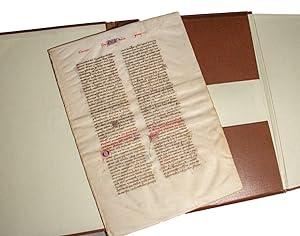
A complete gathering of Vincent de Beauvais Speculum Historiale from the libraries of Guillaume Libri and Thomas Phillipps
Published by France, 1400
Seller: Stephen Butler Rare Books & Manuscripts, London, United Kingdom
Seller rating 5 out of 5 stars
Manuscript / Paper Collectible First Edition
Hardcover. Condition: Near Fine. 1st Edition. Vincent of Beauvais (OP, c.1184-c.1264), Speculum historiale, universal history, in Latin, 8 leaves (a complete gathering, still stitched), 2 columns, 47 lines, red and blue initials with decorative penwork, on vellum, 362 x 260mm., France (Paris), c. 1400 or very early fifteenth century, perfect condition, in a brown cloth folder. From book XXIX (here called XXX ), caps. xxix-xlvii, events for the years 1172-88 in the reign of the emperor Frederick Barbarossa, including the life of Peter Monoculus, abbot of Clairvaux (d. 1186), progress in the Crusades, Joachim of Fiore, the dangers of astrology, wars between France and England, and the loss of the True Cross in 1187: cf. Speculum Historiale ab eximio doctore Vincentio almeque belvacensis, Venice, 1494, fols. 386v-389r. From an important manuscript which belonged successively to Guglielmo Libri (1803-1869, Sotheby s, 1 June 1864, lot 71, to Boone), Sir Thomas Philllipps (1792-1872, his MS 24654, Sotheby s, 24 June 1935, lot 74), bought then by R. Creswick (1902-1988), who removed several loose quires, including this one, before having the manuscript rebound. The bound book itself is now in the Schoenberg Collection at the University of Pennsylvania, LJS 16. The decoration of the Schoenberg volume includes the cascading borders of red and blue half fleurs-de-lys, characteristic of manuscripts made for the French royal family, including the Duc de Berry. A single bifolium from the manuscript was Bloomsbury, 4 December 2018, lot 19 (£1900, hammer). A further two bifolia were sold at the Marvin Colker sale at Christie s, Lot111, 12 Dec. 2022.
-

Couverture rigide. Condition: Très bon. 15x22 cm ; 282 p. Manuscrit écrit en noir et rouge. Pages pliées en cahiers. Le tout sous chemise cartonnée recouverte de cuir avec estampage à froid sur les plats. Dos restauré. L'ensemble sous une chemise cartonnée avec pièce de titre au dos marqué en lettres dorées : Traité d'Eloquence Arabe XVIIIe siècle. et son boitier. Contient en sus 2 pages manuscrites récentes donnant quelques informations sur le manuscrit. L'un nous dit que l'achevé de rédigé en dernière page est marqué Tunis 1219 de l'hégire. redacteur Ali ben abd Allalh ben Mohammed ben Abd Allah ben Ahmad ben Abd Allah ben Amrouben ben Yusuf & Sourhi (pas facile à déchiffer). La deuxième page nous précise que c'est un livre de grammaier El-Katr par Ibnou Hicham. Il précise aussi le changement de propriétaire de ce manuscrit en l'année 1826 de l'ère grégorienne. 8E4.
-
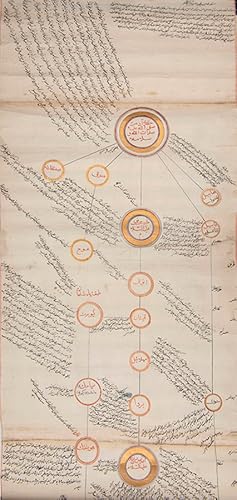
Silsilename, Prepared in the year of the coronation of Sultan Abdülmecid I (r. 1839-61).
Published by Ottoman Turkey dated AH 1839-40 AD, 1255
Seller: Shapero Rare Books, London, United Kingdom
Association Member: ABA ILAB PBFA
Seller rating 4 out of 5 stars
Single scroll, illuminated manuscript on paper formed of 8 membranes (formed of two different paper stocks), in Arabic and Ottoman Turkish, the scroll starts with Adam and finishes with the Ottoman Sultan Abülmecid I, roundels outlined in gold containing names and titles of historical figures in red diwani, linked together with red and blue lines, contemporary annotations and marginalia in black diwani script, dated in the lower left hand corner of the final membrane, a few small smudges or stains, overall clean and attractive condition; housed in modern red cloth box. 8000 x 280mm (315 x 11 inches). Silsilname are geneaological manuscripts, often presented in scroll format, that were popular during the Ottoman Empire where they served as a tool by which Ottoman Sultans could claim legitimise their rule. Although these are generally classed as geneaologies, they often do not follow a strictly linear or chronolical order. This Silsilename begins with Adam and ends with the reign of Sultan Abülmecid I. It includes the ancient Iranian and Turkish Kings, the pre-Islamic Arabs and Prophets, Iskandar Muhammad as well as his ancestors and descendants, the 12 Shi'a imams, the Umayyads, Abbasids, Buyids, Samanids, Ghaznavids, Seljuks, Khwarazmshahis, the Chingizids and the Ottomans.
-
Varidat-i Mensure we Divan, A collection of mystical treatise in poetic form, copied for Hashim Mustafi bin Sheikh Yusif., by Muhammad Amin.
Published by Ottoman Turkey dated AH 1829-30 AD, 1245
Seller: Shapero Rare Books, London, United Kingdom
Association Member: ABA ILAB PBFA
Seller rating 4 out of 5 stars
Single volume, illuminated manuscript on paper, in Arabic and Ottoman Turkish, 101 leaves plus four fly-leaves, complete, single column, 19 lines of black naskh with important words picked out in red, within gold and black rules, margins with occasional commentary, catchwords, headings in red naskh on illuminated panels, opening bifolium with gold stencilled floral arabesques and illuminated headpiece, the final bifolium with similar illuminated margins, clean and crisp internal condition; housed in fine contemporary gilt tooled leather binding with flap, the doublures marbled paper, a very good copy. 195 x 116mm (7¾ x 4½ inches). Sayyid Hashim Mustafa al-Uskudari al-Jalwati (Hashim Mustafa Uskudari), known as Hashim Baba, was a poet that spent much of his life preaching for the Sufi orders under the influences of Celvetism and Bektashism. He was born in Uskudar in 1718 AD and is responsible for compiling a vast collection of prose writings on numerous subjects including prognostication (jafr) and the numerology of the alphabet (abjad), were widely read and are found together as a single volume, now housed in numerous collections including the Suuleymaniye Library. Varidat-i Mensure ve Divan-i Menzume (the Prose Inspirations and the Poetic Divan) is a collection of mystical treatise in poetic form that was considered a highly regarded reference source amongst the followers of the Celveti order.
-
Majma' al-Tawarikh, commissioned for the Timurid Sultan Shah Rukh,
Published by Timurid Herat c. -1426 AD, 1425
Seller: Shapero Rare Books, London, United Kingdom
Association Member: ABA ILAB PBFA
Seller rating 4 out of 5 stars
Single volume, illuminated manuscript on brown Herati paper, in Farsi, 2 leaves (from 2 different paper stocks), each leaf 423 x 323mm; text in single column, 32 lines fine scribal black naskh, the title of the chapter in large red thuluth and important names in red naskh, text framed within double ruling of red and blue, fol. 1r with illustrations of four Chinese rulers (completed in an early hand), fol. 2r with illustration of enthroned ruler receiving a courtesan (illustration by a later hand, likely painted in Iran c.1900-1925), both illustrations pasted onto the leaves (taken from different pages in the same manuscript), leaves mounted on stubs, first folio washed with some smudges to ink, remains of adhesive to upper margins of both leaves from earlier mounting, pencil inventory number '1960.129' to first leaf and '1960.144' to second; housed in modern burgundy cloth, morocco label to upper cover. These leaves originate from the famous illustrated copy of Hafiz-i Abru's Majma al-Tawarikh ('Universal History') originally commissioned by the Timurid ruler Shah Rukh. The text is an historical treatise encompassing Biblical, Iranian, Islamic and Chinese history up until Shah Rukh's reign (1405-47). The work was based on Rashid al-Din's Jami' al-Tawarikh (Gatherer of Chronicles), a universal history first compiled for the Mongol ruler Ghazan to legitimise the ruling dynasty by giving it a formal historical pedigree. Fellow historian Hafiz-i Abru (d. 1430) was commissioned this lavish work to serve the same purpose as Rashid al-Din Jami's text of legitimising Shah Rukh's rule of the Persian Empire. The Majma al-Tawarikh was written between 1423 and 1426 and is partly based on an earlier work, the Jami al-Tawarikh (Gatherer of Chronicles), ordered by the Ilkhanid ruler Uljaytu and compiled by his minister Rashid al-Din at the Rab'-i Rashidi scriptorium at Tabriz in 1314. The text consists of four parts: a history of the world up to the Arab conquest; a history of the Caliphate until 1258; a history of Persia during the Seljuk and Mongol periods; and the Zubdat al-Tawarikh, which chronicles the lives of Timur and Shah Rukh until 1427. There are two extant copies: a dispersed manuscript formerly in the collection of Emile Tabbagh and Parish Watson, and the other copy, dated AH 829/AD 1425, is in the Topkapi Saray Library, Istanbul (H. 1653). For more information on this manuscript see: S. Canby, Princes, Poets and Paladins: Islamic and Indian Paintings from the Collection of Prince and Princess Sadruddin Aga Khan (London 1998, pp. 28-31); T. Lentz and G. Lowry, Timur and the Princely Vision: Persian Art and Culture in the Fifteenth Century (Los Angeles and Washington 1989, pp. 98-102). This codex has undergone a series of transformations since its composition in the fifteenth century. At the time of copying, there were a large number of empty spaces within the body of the text left that were never completed by a contemporary artist. These were later completed by a workshop in Iran in the early 20th century, when leaves with 'original' illustrations were cut and pasted to other pages from the same manuscript (presumably to give a better aesthetic quality to these folios), and dispersed by art dealers. The two present leaves both show evidence of this history: the illustration of the four Chinese emperors are contemporary illustrations executed in Shah Rukh's workshop, but the image has been pasted onto an unillustrated folio belonging to the history of Buddha from the same manuscript. The illustrations of the enthroned king in the second folio is modern addition to a folio transcribed in Shah Rukh's library.
-
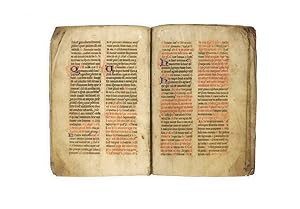
Sarum Breviary, in Latin.
Published by England, first quarter of fifteenth century., 1400
Seller: Bernard Quaritch Ltd ABA ILAB, London, United Kingdom
Association Member: ABA ILAB PBFA
Seller rating 5 out of 5 stars
21 leaves (211 x 137 mm (154 x 96 mm)), written in double columns in two sizes of a good gothic liturgical script, dark brown ink, ruled lightly with ink, horizontal catch-words, numerous two-line initials in blue with fine red penwork incorporating leafy designs, one-line initials in blue, occasionally with red penwork, paragraph marks in blue, rubrics; dust-soiled and stained, worn in places, a few wax stains, one or two natural vellum flaws, corners creased and sometimes slightly crumpled, a few marginal tears and slight losses, but almost entirely legible, preserving pricking in outer margins; disbound, housed in a green cloth box.A fragment of twenty-one leaves from a portable Sarum Breviary, with nineteenth-century Staffordshire provenance.The leaves here come from the Temporal of a 'secular' Breviary (i.e. for use in a church, either by a parish priest or a friar), containing nine readings at Matins for Sundays and major feast days and three readings for weekdays (monastic Breviaries give twelve readings for Sundays and feast days and three for weekdays in the winter and one in summer). Included are prayers and readings for the feasts of St. Stephen, St. John the Evangelist, Holy Innocents, and St. Thomas, and for the third and fourth weeks in Advent, Christmas Eve, and the week after Epiphany.Provenance: Rev. William Jackson of Staffordshire, according to accompanying notes by his son William J. Marsh Jackson of Smethwick, formerly in that county. The first note, dated April 1887, states that the manuscript 'formed part of the library of my father the Revd. Wm. Jackson MA and had been in his possession ever since I can remember, ie over 40 years'. The second note mentions, inter alia, that Jackson senior was vicar of Adbaston (Staffordshire). Language: Latin.


![Seller image for Tarikh'i Pitr'i Kabir [and] Tarikh'i Sharl'i Davazdahhum, Histories of Charles XII and Peter the Great, translated from Voltaire's 'Histoire de l'empire de Russie sous Pierre-le-Grand'. for sale by Shapero Rare Books](https://pictures.abebooks.com/inventory/md/md32338553236.jpg)


![Seller image for Decretales Gregorii IX [with gloss of Bernardo Bottoni of Parma]. Constitutiones novellae Innocentii IV [with gloss of Bernard of Compostella iunior]. Latin manuscript on vellum. for sale by Antiquariat INLIBRIS Gilhofer Nfg. GmbH](https://pictures.abebooks.com/inventory/md/md32073428356.jpg)
![Seller image for Summa de casibus poenitentiae [abridged]. [Incipit:] Symonia int[er] crimina eccl[es]iastica p[ri]mu[m] optinet locum for sale by Bruce McKittrick Rare Books, Inc.](https://pictures.abebooks.com/inventory/md/md32071178869.jpg)
![Seller image for Quaestiones in decem libros ethicorum, [manuscript fragment C14th] for sale by Stephen Butler Rare Books & Manuscripts](https://pictures.abebooks.com/inventory/md/md31980674070.jpg)
![Seller image for Al-Qanun fi al-Tibb [The Canon of Medicine]. for sale by Antiquariat INLIBRIS Gilhofer Nfg. GmbH](https://pictures.abebooks.com/inventory/md/md31918275893.jpg)
![Seller image for Al-Husami [Al-Muntakhab fi Usul al-Madhhab]. for sale by Antiquariat INLIBRIS Gilhofer Nfg. GmbH](https://pictures.abebooks.com/inventory/md/md31878844327.jpg)